Radio DJs and the Shaping of Popular Taste
Before algorithms and streaming platforms decided what listeners would hear next, that job belonged almost entirely to a single person sitting behind a radio console: the disc jockey. In the early 1950s, radio DJs were already far more than announcers reading record labels into a microphone; they were tastemakers who decided which songs received airplay, which artists broke out of regional markets, and which sounds crossed over from the margins of American music into its commercial mainstream. Their choices, night after night, shaped the listening habits of a generation of American teenagers who were, for the first time, buying records and radios of their own. This piece examines how radio DJs of the 1950s helped shape the explosive arrival of rock and roll, how their influence became powerful enough to trigger a national scandal, and how their legacy still echoes in the way music reaches audiences today.
The Disc Jockey as Gatekeeper
In the years before formal Top 40 programming consolidated playlists across the industry, individual disc jockeys at local and regional stations typically chose much of what they played themselves, giving them enormous personal influence over which records found an audience. Record promoters cultivated close relationships with popular DJs, well aware that a single enthusiastic on-air play could turn an obscure regional single into a request-line favorite within days. Cleveland and later New York DJ Alan Freed is widely credited with popularizing the term “rock and roll” on the air to describe the blend of rhythm and blues he championed for young, increasingly integrated audiences, and he went on to host live rock and roll dance shows that drew enormous crowds of teenagers. In Memphis, DJ Dewey Phillips played a young Elvis Presley’s first single on WHBQ in 1954, giving the singer his first real exposure to a local audience months before national fame arrived. These were not passive broadcasters; they were active curators whose personal enthusiasm, and occasionally their personal financial incentives, helped determine what the rest of the country would eventually hear.
Crossing Racial and Regional Lines
Radio’s influence on rock and roll’s spread was inseparable from the racial landscape of American broadcasting in the 1950s. Rhythm and blues recordings by Black artists were frequently confined to stations and time slots serving Black audiences, while mainstream pop stations favored smoother, more conventional fare. Adventurous DJs who began playing R&B records for broader teenage audiences, regardless of the race of the performer, helped dissolve those informal boundaries, exposing white teenagers to sounds and rhythms largely new to them and accelerating the stylistic blending of blues, country, and gospel that defined rock and roll. High-powered AM stations could carry their signals hundreds of miles after dark, meaning a daring broadcast from one city might reach impressionable teenage listeners in several states, well beyond anything a local record label or retailer could achieve on its own. That reach helped transform rock and roll from a scattering of regional trends into a genuinely national phenomenon, closely tied to the broader story of how rock and roll was born in the 1950s.
Historical Context
Radio in the early 1950s was organized largely around local and regional stations, many of which maintained informal or explicit separation between programming aimed at Black and white audiences. Rhythm and blues recordings were often categorized by the industry as “race records” and confined to stations serving Black listeners until crossover-minded DJs began playing them more broadly. High-powered AM signals allowed some nighttime broadcasts to reach listeners hundreds of miles from their home station, accelerating the regional spread of new sounds well before national distribution caught up.
Payola and the Limits of Influence
As individual DJs’ power over what the public heard grew, so did the temptation for record labels and promoters to pay for favorable airplay, a practice that became widely known as payola. Congressional hearings held in 1959 and 1960 investigated undisclosed cash and gift payments made to disc jockeys in exchange for playing particular records, and the scandal badly damaged the career of Alan Freed, who admitted to accepting undisclosed payments even though the practice had long been treated as common, if unspoken, industry custom. The resulting regulations explicitly required broadcasters to disclose any payment received in exchange for airplay, and stations, wary of further scandal, increasingly moved toward centralized, format-driven programming overseen by station management rather than individual DJs choosing freely. That shift gradually diminished the freewheeling, personality-driven style of radio that had defined rock and roll’s breakout years, even as it professionalized the business of getting a record played.
For a few crucial years in the middle of the twentieth century, the fate of a record, and sometimes an entire genre, rested on whether a single disc jockey decided it was worth spinning twice.
From Airwaves to Record Store Counters
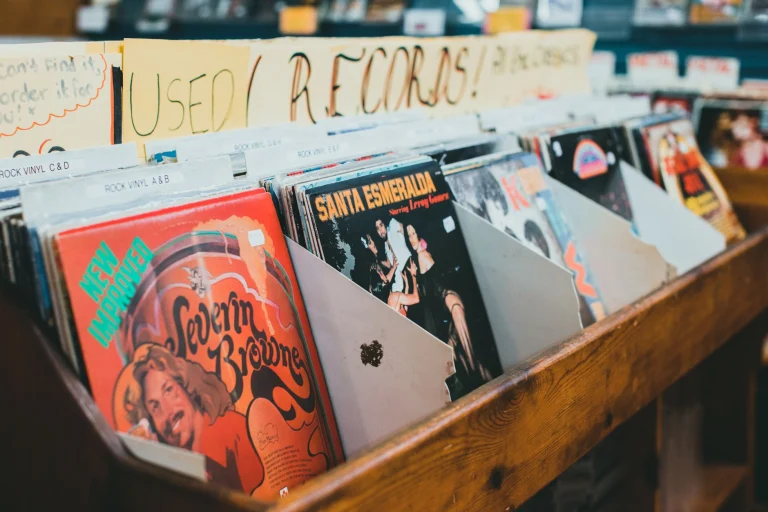
Radio airplay translated directly into retail demand: a song heard repeatedly on a local station sent teenagers straight to the counter of their neighborhood record store the following weekend, a dynamic closely tied to the record store era and how fans discovered music. As formats consolidated through the 1960s and new technologies offered fresh ways to encounter music, including television and eventually the arrival of MTV and the music video revolution decades later, the singular cultural power once held by the local radio DJ gradually diminished. Still, the basic function those early DJs performed, curating what the wider public would hear next, never disappeared; it simply migrated to new gatekeepers and new formats, a pattern that would repeat itself again when the British Invasion transformed popular music by relying on American radio and television exposure to introduce British bands to domestic audiences just a few years later.
An Enduring Model of Curation
Though the specific mechanics of music discovery have changed many times since the 1950s, the underlying role that radio DJs invented, standing between an overwhelming volume of recorded music and an audience with limited time and attention, has never gone away. Music directors, video programmers, and eventually streaming algorithms have all, in their own ways, inherited the basic task those early broadcasters performed instinctively: deciding what deserves to be heard next. What distinguished the DJs of the 1950s was the personal, idiosyncratic nature of their authority; listeners trusted a familiar voice’s taste in a way that would be difficult to replicate with an anonymous recommendation engine. That personal credibility is part of why collectors and historians still study figures like Alan Freed and Dewey Phillips as pioneers, not merely as broadcasters who happened to be in the right city at the right moment, but as active participants in deciding which version of American music would reach the largest possible audience.
Sources & Further Reading
- Broadcast history archives and retrospectives on early rock and roll radio
- Congressional hearing records related to the payola investigations
- Music journalism profiles of pioneering disc jockeys
- Academic studies of radio’s role in postwar American youth culture
- Documentary and biographical accounts of early rock and roll broadcasters